Nonstick vs Stainless Steel: Picking Pans for Weeknight Cooking
A scenario-based comparison of nonstick and stainless steel skillets for everyday weeknight cooking, with honest tradeoffs on heat, care and lifespan.
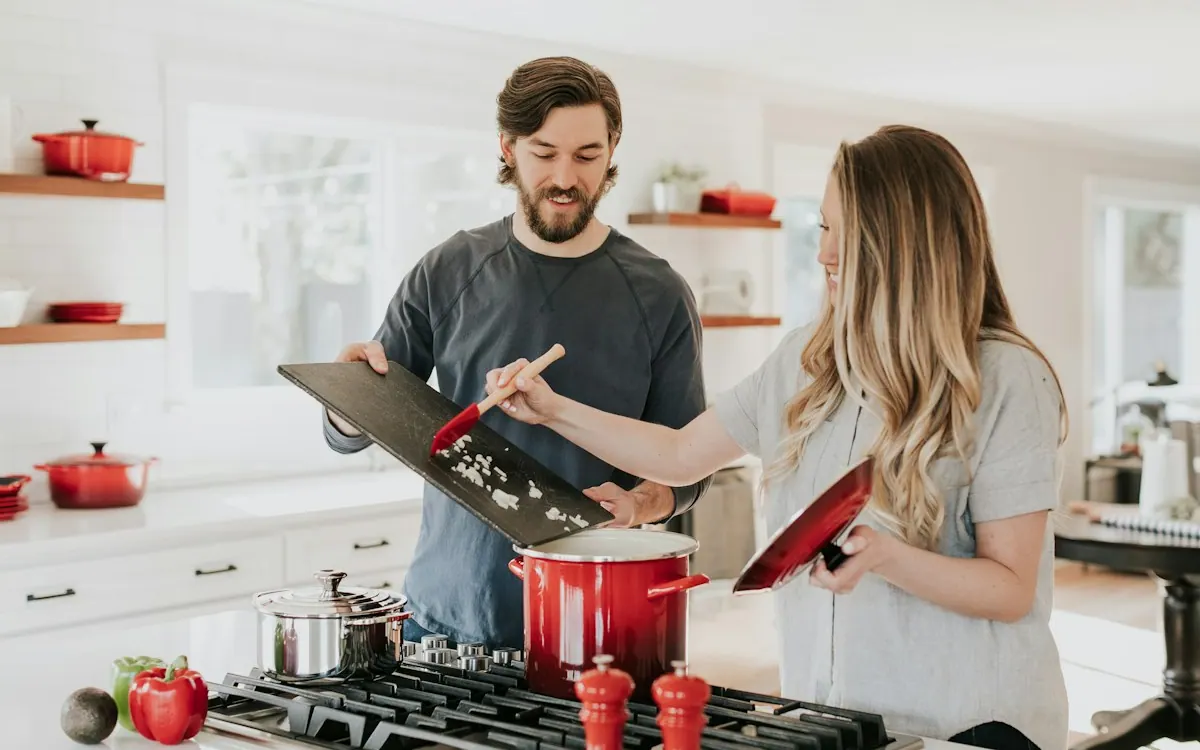
It is just past 8pm in a rental kitchen, and two people are trying to get pasta on the table. One pan is already in the sink under a film of tomato sauce, the free burner is the small one at the back, and the cupboard door stops halfway when it hits the fridge. Whoever scrambles eggs tomorrow and whoever sears a chicken thigh on Friday are the same person reaching into the same narrow shelf. That is the honest version of the nonstick-versus-stainless question: not which skillet wins in a test kitchen, but which one earns the single easy-to-grab slot on a Tuesday night.
Most comparisons end with a verdict, which is little help when the decision spans half a dozen meals. Eggs, a hard sear, a pan sauce and a high-heat char each ask something different of a pan. Sorting the choice by what goes into the skillet makes the tradeoffs concrete, and it explains why so many small kitchens end up owning two.
Reading the two surfaces
Nonstick is a coating on a metal body, usually aluminum. In published product listings it is generally listed as a low-to-medium-heat pan that wants non-metal utensils and a gentle wash, and in exchange delicate food releases with very little fat. Stainless steel is bare metal, often a clad sandwich with an aluminum core. Manufacturers commonly describe that construction as even-heating and suitable for high heat and metal tools, with the catch that the surface needs a proper preheat and enough oil to keep proteins from grabbing. These are two sets of instructions, not a ranking.
A scenario-by-scenario comparison
| Scenario | Nonstick | Stainless steel | Better fit |
|---|---|---|---|
| Eggs, pancakes, delicate fish | Releases with minimal oil | Sticks unless preheated and oiled | Nonstick |
| Searing a steak or chicken thigh | Coating is generally listed as unsuited to high heat | Builds a browned crust | Stainless steel |
| One-pan sauces and deglazing | Little fond forms | Fond is the point of the pan | Stainless steel |
| High-heat stir-fry or charring | Heat ceiling and soft surface work against it | Handles the heat and a metal spatula | Stainless steel |
A pattern emerges. Nonstick wins the low-effort, moderate-heat, delicate-food jobs: anything eggy, cheesy, fishy or likely to sit in the sink. Stainless steel wins anything built on browning, high heat or a sauce lifted from the drippings left behind. If your week is mostly the first column, buying stainless because it sounds more serious just adds scrubbing to your mornings.
When two pans beat choosing one
The clearest case for two pans is a week that genuinely splits. A nonstick skillet for eggs and reheating, plus one clad stainless skillet for searing and pan sauces, covers nearly every weeknight task without either pan doing the job it is bad at. The two usually nest into roughly the footprint of one bulky pan with its lid. Choosing one makes sense only when your cooking leans hard one way — a household living on fried eggs has little use for fond, and one that sears protein four nights a week will wear out a coating fast.
The tradeoffs nobody puts on the box
Heat comes first. Published care guidance commonly describes high heat as the thing that shortens a nonstick coating’s life, while bare stainless tolerates temperatures that would ruin one. Based on published specifications, lifespan runs the other way: a clad pan is generally listed as a long-lived, essentially renewable surface, whereas nonstick is a consumable that eventually needs replacing.
Cleaning is a wash, not a win. Nonstick releases food but forbids abrasive scrubbers; stainless tolerates a scouring pad but asks you to soak and deglaze. Tri-ply is heavier to lift one-handed from a low shelf, and a thin aluminum pan can warp under a powerful burner while a heavier clad pan sits flatter on a glass top. None of this shows up in a photo, and all of it shows up after a month of use.
Who should skip it
If you already own a well-seasoned cast-iron or carbon-steel skillet, a second stainless pan is mostly duplication. If you cook exclusively over high heat and want one pan for a decade, a coated skillet will frustrate you. And with a single shallow drawer, be honest about which column describes your actual week before committing.
A short checklist before you buy
- Match the pan to the meals you cook most, not the ones you cook for guests.
- Check the cooking-surface diameter; a 10-inch and a 12-inch behave very differently on one burner.
- Confirm the handle and body are listed as oven-safe if you finish dishes in the oven.
- For nonstick, check the recommended heat range and utensil guidance.
- For stainless, confirm clad construction and cooktop compatibility, especially glass tops.
- Decide now whether you are buying one pan or building a two-pan setup.
The picks below are the categories worth comparing first. Prices move constantly, so check current price and availability on the retailer page before you commit — and read the diameter, oven-safety and cooktop details on the listing itself, since those vary between pans that look nearly identical in a photo.
Picks worth comparing
These are product categories to compare, not a ranked list. Recommendations are based on published specifications and household fit. Check the retailer page for current price, size and availability.
10-inch nonstick aluminum skillet
Best everyday weeknight pan — Eggs, pancakes, fish fillets and quick reheating for one or two people.
What to check
- Aluminum core is generally listed as lightweight and quick to heat
- Nonstick coating is commonly described as requiring low to medium heat
- Typically sold with a stay-cool handle and sloped sides for sliding food out
Pros / tradeoffs
- Delicate foods release with little oil and minimal scrubbing
- Light enough to lift one-handed from a crowded cupboard
- Coating is generally listed as not suited to high heat or metal utensils
- Surface typically needs replacing sooner than bare metal
Prices change often. Check the retailer for the current price and availability.
12-inch tri-ply stainless steel skillet
Best for searing and pan sauces — Searing proteins, building fond and finishing a one-pan sauce.
What to check
- Clad construction with an aluminum core is commonly described as distributing heat evenly
- Uncoated cooking surface is generally listed as safe for high heat and metal tools
- Usually sold with a helper handle and an oven-safe body
Pros / tradeoffs
- Develops the browned bits that make a quick pan sauce taste slow-cooked
- Bare metal tolerates high heat, broilers and metal spatulas
- Requires preheating and enough fat to keep proteins from sticking
- Heavier than a comparable nonstick pan
Prices change often. Check the retailer for the current price and availability.
10-inch hard-anodized nonstick skillet
Best longer-lived nonstick option — Cooks who want nonstick release with a surface that handles a bit more heat.
What to check
- Hard-anodized aluminum is commonly described as more scratch-resistant than standard nonstick
- Typically listed as oven-safe to a moderate temperature
- Often sold with a reinforced, non-slip handle
Pros / tradeoffs
- Tougher surface than a basic coated pan at a similar footprint
- Still gives low-effort release for eggs and sticky glazes
- Heavier than plain aluminum nonstick
- Still a coated surface, so high heat and abrasive scrubbers remain off-limits
Prices change often. Check the retailer for the current price and availability.
Common questions
Not ideally. Nonstick is built for low-friction, moderate-heat cooking, and stainless steel is built for high heat and browning. A single pan can limp through either job, but the one you reach for most nights should match the food you cook most often.
It is different, not necessarily harder. Based on published care guidance, soaking a stuck-on pan and using a non-abrasive scrubber handles most residue, and a properly preheated pan with enough oil rarely sticks badly in the first place.
When your week splits between delicate, quick-cook foods and anything you want deeply browned. A nonstick for eggs and a clad stainless skillet for searing cover nearly every weeknight task, and the two nest into roughly the same footprint as one bulky pan plus its lid.
Four things: the cooking-surface diameter, whether the handle is oven-safe and to what temperature, whether the body works on your cooktop, and whether the nonstick coating is described as safe for the utensils you actually own.